

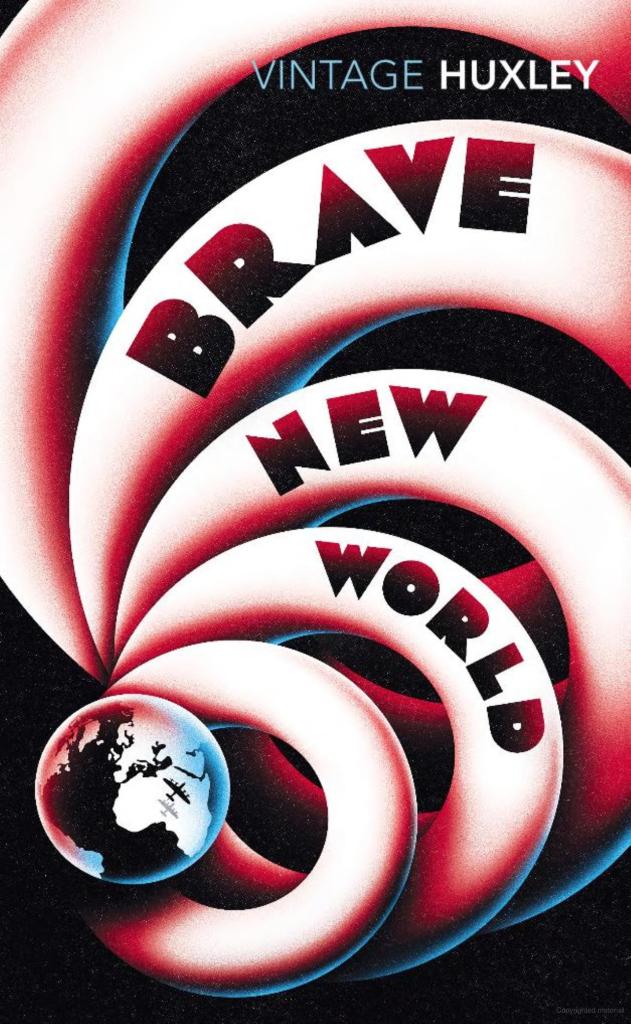
Synopsis
Welcome to New London. Everybody is happy here. Our perfect society achieved peace and stability through the prohibition of monogamy, privacy, money, family and history itself. Now everyone belongs.
You can be happy too. All you need to do is take your Soma pills. (Source: Amazon)
A World of Conditioned Happiness!
The word dystopia is often used to describe dark and gritty potential futures. From Dicks’ world, where owning live animals is considered a status symbol (Do Androids Dream), to worlds where you are constantly being monitored and watched (Orwell’s 1984), these are worlds where sadness and misery rule the roost. Huxley’s vision for a dystopian society in Brave New World, then, offers something totally unique to the genre: a dystopia in which everyone is happy, at least on the surface.
In creating his vision, Huxley begins with an introduction to his dystopian reality. Comprising the novel’s first 1/3, the introduction takes shape by following a group of students on a tour of a cloning factory. As they visit each step in sequential order, one of the factory’s bosses provides a detailed explanation of the process.
More than a mere unique delivery device, this tour comprises the novel’s strongest moments and perhaps even some of the most important words ever put to paper. As each part of the cloning process is explained, it quickly becomes apparent that these are used to disguise a step-by-step guide to creating a mould for a mindless society.
Clones make for an easier transfer in Huxley’s dystopian world. It means that, in one way or another, everyone belongs to one another. Moreover, with a population grown in a lab, the higher-ups can easily impart their influence. During their development stages, the clones are all separated into one of several different groups before undergoing a series of conditioning measures. Each of these groups is only taught what they need to know, with the rest of their education dedicated to learning how to hate the other groups of clones. Perfect for the ones in charge who would lose everything in the event of an uprising.
Unfortunately, Huxley’s visionary novel doesn’t manage to keep the same lustre as it moves towards its main characters and plot. As the citizenry of this dystopia is introduced, Huxley loses his revolutionary edge in favour of views lost to progress and his own fetishes. Sex, drugs, and the homogeneous meld take control here, and it gets old quickly.
Furthermore, the entire cast of characters is insufferable, the women in particular. Huxley clearly follows an old-fashioned way of thinking, as every woman is flighty, demure, and eager to please. I wouldn’t say that I normally pay attention to these types of characterisations when I read; classic sci-fi often has them here and there, but even I couldn’t ignore the rampant misogyny displayed here. As a result, I only managed to make it halfway through the novel before calling it a day.
An undeniable classic yet ultimately flawed. Huxley’s Brave New World revolutionised the meaning of a dystopia, but its characters and overall attitude have failed to stand the test of time. It’s difficult to decide whether or not to recommend this book; all I know is that you should read the first 1/3 and decide for yourself.
I Give a Brave New World: 6/10
If you like what you read and what I do, why not consider supporting me through Ko-Fi. Any donation helps keep this site up and keep me writing.
Brave New World can be picked up at most major online stockists.
 Faceless One Blog
Leave a comment