

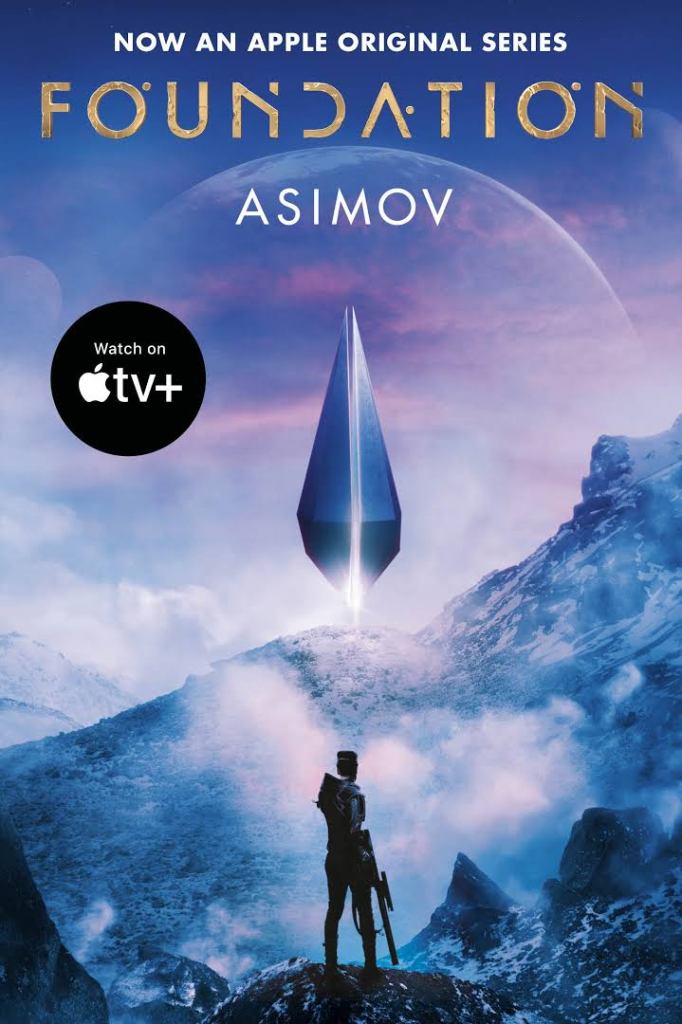
Synopsis
For twelve thousand years the Galactic Empire has ruled supreme. Now it is dying. But only Hari Seldon, creator of the revolutionary science of psychohistory, can see into the future–to a dark age of ignorance, barbarism, and warfare that will last thirty thousand years. To preserve knowledge and save humankind, Seldon gathers the best minds in the Empire–both scientists and scholars–and brings them to a bleak planet at the edge of the galaxy to serve as a beacon of hope for future generations. He calls his sanctuary the Foundation. (Source: Goodreads)
A Guide to Creating an Intergalactic Empire!
Taking place in the far future, Asimov’s Foundation is both immense in scale and ambition. A story of conquest and power, the series sets about showing what it takes for a planet to become the centre of a galactic empire. As the first book in the series, the aptly named Foundation lays out the beginnings of Hari Seldon’s ultimate wish as his exile planet Terminus sets its sights on becoming a universal superpower over five parts.
Part 1
Getting the series off to a strong start, the story begins before Seldon’s rise and the creation of the planet Terminus. Living at the centre of a dying empire, Seldon is shown as an influential researcher with almost cult leader-like qualities.
These segments are shown through the point of view of Gaal Dornik, a country bumpkin and newly hired researcher for Seldon. Upon his arrival at the galactic capital, Dornik is thrust into a world of conspiracy and subterfuge, as he quickly discovers that Seldon’s views on a dying empire have made him a very unpopular man.
Through Dornik’s perspective, Asimov does a great job of visualising the empire’s decay. There’s a wonderful bit of juxtaposition, as Dornik’s excitable attitude towards visiting the home world and seeing it from above is in complete contrast to a world whose population sits under a constant grey sky and never willingly wants to leave its underground metropolis. With little desire to explore beyond the confines of their world, it is no wonder that the empire is slowly crumbling.
Moreover, the story’s first part admirably showcases Asimov’s view that words can be more powerful than war. Seldon’s status in the galactic home world is settled through trial rather than a shootout.
Parts 2 and 3
As a consequence of Seldon’s actions, the story continues in the second and third parts from the world of his exiled followers, Terminus. These parts come from the perspective of Salvor Hardin, Terminus’ mayor and middleman between the general population and the encyclopaedists.
Unlike Dornik, Hardin is instrumental in Seldon’s vision for Terminus’ future as a galactic superpower. Using non-violent action and his intelligence, Hardin negotiates Terminus through its first two crises and overpowers its more powerful neighbours.
During these two parts, Asimov weaves one of the novel’s central themes: religion as a means of control. Asimov sees religion as a great tool to suppress societies, especially primitive ones. As its leaders, the higher-ups of Terminus can control what will incur the wrath of God, thus suppressing any chance of a more powerful nation turning against them.
As an aside, these parts also introduce some of Asimov’s famously good world-building. In Foundation, this is all about the little things and is best represented by how characters say expletives such as “by space” rather than “by God.” It makes the universe they inhabit more believable.
Parts 4 and 5
The final two parts of the story signal a change for the people of Terminus. Now in control of a sizeable portion of their part of the galaxy, and other planets becoming weary of their schemes, Terminus and the new protagonist, Hober Mallow, turn to trade and capitalism rather than religion to take control.
The weakest part of the story, these parts play more as the build-up to a sequel. With a third crisis putting them at odds with the old galactic empire, it seems inevitable that the two will come into conflict with one another as the series continues.
Overall, Asimov’s Foundation is one of his greatest creations and a clear classic that everyone should read at least once in their life. What makes this an unmissable classic comes from its ambitious scope, clear grasp of themes, and Asimov’s wonderful style of writing. There are very few who can pull this off, and I hope this excellence continues into its sequel
I Give Foundation: 10/10
If you like what you read and what I do, why not consider supporting me through Ko-Fi. Any donation helps keep this site up and keep me writing.
Foundation can be picked up at most major online stockists.



 Faceless One Blog
Leave a comment