
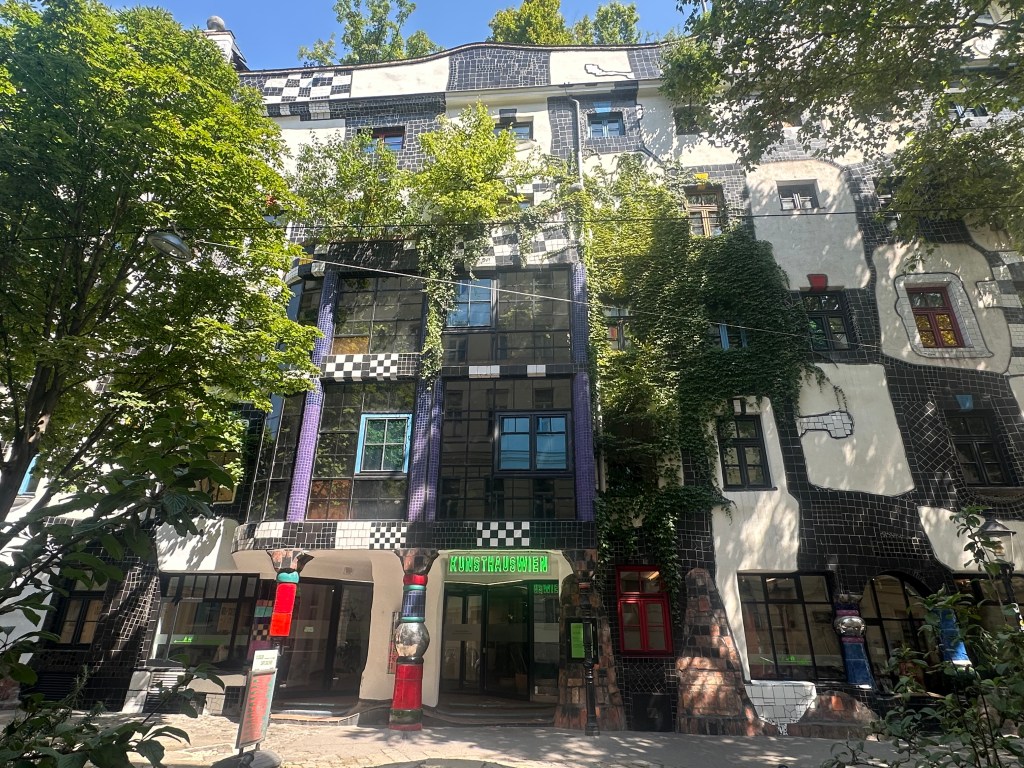
When picturing Vienna, I bet you, like many of us (myself included), would envision a city of grand façades, marked by the unmistakable opulence of the Habsburg dynasty, and a city marked by the influence of the Germanosphere’s rigid efficiency. What may not come to your mind, however, is a view of the city that can be found just a metro stop or two away from the historic centre…
Hidden away within the leafy surrounds of Vienna’s Landstraße district, the city’s 19th-century grandeur makes way for a house full of odd shapes and colours, with trees and annexes jutting out and shading the pavement beneath. This building, alongside several others in the district, is the architectural achievement of one of Europe’s most important postmodernists, Friedensreich Hundertwasser.
Hundertwasser: Artist, Architect, Environmentalist
Born Friedrich Stowasser in 1928, Hundertwasser’s start in life was rough, formed under the persecution of Nazi-occupied Austria. Although he survived the regime thanks to his father’s Christian heritage and his family’s savvy idea to have him join the Hitler Youth, 69 of his relatives weren’t so fortunate. Amidst these harsh realities, Hundertwasser found his talent for art.

Developing his style over the coming decade, what formed was a style characterised by vivid colours, spirals, and a distaste for the straight line. Alongside his unique artistic vision, Hundertwasser developed a passionate interest in environmentalism and environmental protection. Believing in the need for coexistence between man and nature, he lectured on the planting of trees in urban environments and manifested against the use of sterile and rational architecture. Later in life, his passions for art and environmentalism ultimately collided, leading him towards architectural projects aimed at transforming the monotonous urban cityscape.
Hundertwasserhaus and KunstHausWien
Within the centre of Landstraße, the artist’s crowning achievement, the Hundertwasserhaus, stands as more than just a quirky departure in the fabric of Vienna’s urban design. Opened in 1985, this set of apartment blocks truly encompasses Hundertwasser’s environmental and philosophical ideals. Along its walls, the straight line has abandoned its colourful façade in favour of an eclectic mix of shapes and mosaics. Moreover, trees and assorted greenery grow in harmony with the buildings’ foundations and can be found both on high and down low.

Although the building’s features can only be admired from a distance (the Hundertwasserhaus is a private residence), the nearby Hundertwasser Village and ground-level café offer a glimpse into its unique features and architectural wonders.
Further along Landstraße, towards the Donaukanal, the KunstHausWien beckons visitors with its neon signage. A mosaic of black and white, this later example of Hundertwasser’s architectural designs now holds a permanent exhibition of his works.
This fascinating yet strangely underrated museum explores the artist’s life across two floors. On the first floor, the exhibits showcase Hundertwasser’s artistic flair through more traditional media. His works on canvas are as vibrant as his buildings, often creating a powerful, vibrating tonality with his mixes of bright greens, blues and pinks.

On the second floor, the museum displays exhibits honouring Hundertwasser’s larger projects. Here, visitors can discover the essence of his environmental and architectural ambition with several small-scale models that detail the thought processes that went into their harmonious designs. One of which, the Spittelau Incinerator, not only exists today but also demonstrates Hunderwasser’s pragmatism towards a greener future, as he agrees that, despite how green we can become, there will always be some level of waste.

If you would like to learn more about Hundertwasser and his artistic environmentalism, check out his website:




 Faceless One Blog
Leave a comment