

First airing in 1990, One Foot in the Grave was a dark sitcom following the exploits of Victor Meldrew, whose bad luck has him caught up in all sorts of scrapes and situations. Producing 44 episodes over ten years, the show was (and still is!) extremely popular, winning numerous awards and constantly raking in tens of millions of viewers. With such immense popularity, however, there came a problem. How do you give the series a strong ending with a sense of finality? “Things Aren’t Simple Anymore”, the series’ swansong, provided these solutions in spades.
Margeret finds it hard to cope after the death of Victor, but what will she do when she is face to face with his killer?
IMDB synopsis
The episode starts with Margaret (Annette Crosbie), Victor’s long-suffering wife, talking on an absurd phone shaped like a football boot. She’s on the line, dealing with another one of Victor’s (Richard Wilson) many victims. In his latest curmudgeonly act, it seems like Victor has maimed someone by sticking a hypodermic needle in their bottom. As if to juxtapose the hilarity, however, it is quickly revealed through this conversation that Victor has recently passed away. While this comes as a surprise, it certainly isn’t a shocking one.
Over its 44-episode run, there was always a sense that the series would end this way. By the time it came for the finale, Victor had already collected a catalogue of grievances, and previous specials, such as “Starbound”, had already laid the groundwork with its own death fake-out. What made this episode special, however, wasn’t that the show chose to kill off Victor, but rather how it chose to do so. Far away from the worlds of revenge, fights and the occasional deranged psychopath, Victor’s death in “Things Aren’t Simple Anymore” is a random act.
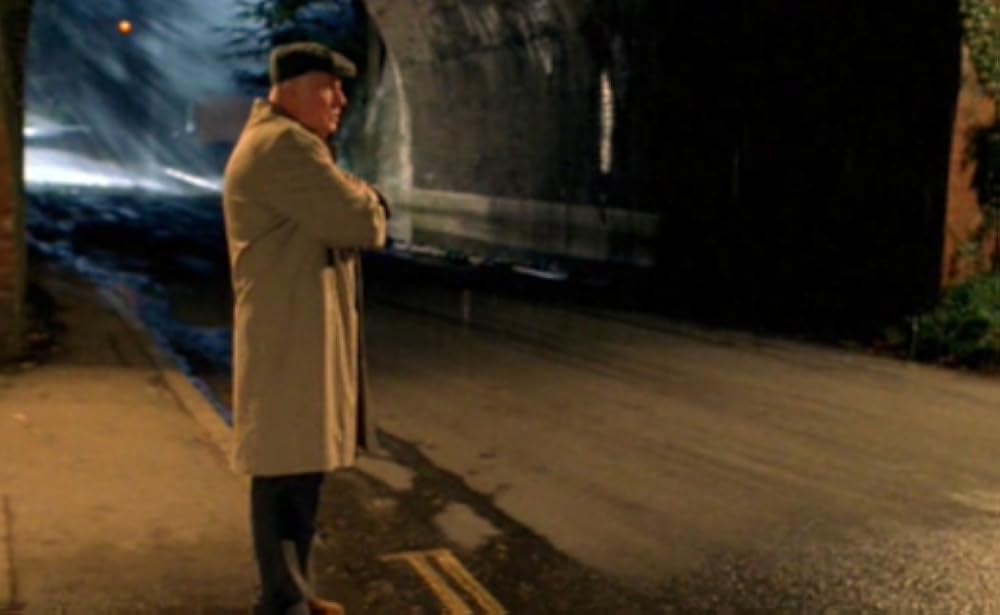
On his way back from a work reunion, Victor is run over by a speeding driver. This person has no connection to Victor and just happened to be passing by at the wrong place at the wrong time. With this act of randomness, the show creates a moment of pure brilliance. It highlights the unpredictability of life and shows that death comes to everybody, even for someone whose crotchety old man syndrome seemed to make him indestructible at times.
Victor’s death also brings with it a new role for Margaret. Beside herself with grief, she spends the episode attempting to reckon with Victor’s passing by plotting her own revenge scheme. This plot is a significant role reversal for Margaret’s character. Up until this point in the series, Margaret has played a passive role and has often attempted to fix or has suffered from Victor’s many fights. Her husband’s untimely death, however, proves to be transformational for her agency, as she uses the same methods that her husband used to seek her own type of justice.

Margaret’s actions work well within the narrative because they challenge the conservative nature of sitcoms. In a form of television that tends not to vary wildly from its concept, Margaret’s breakaway from the role of a passive, long-suffering wife is a radical step, which elevates the show’s ending and its reasoning for killing off its main protagonist.
Ending a ten-year phenomenon, “Things Aren’t Simple Anymore” successfully manages to bookend One Foot in the Grave on a high note. Challenging the conservative trappings of the sitcom genre, it chooses to kill off its protagonist whilst simultaneously managing a role reversal that plays against typical character and gender roles.
What are your thoughts on this era? What would you like me to review next? Share your thoughts by leaving a comment down below! Alternatively, you can help support the blog by donating through Ko-Fi.
Why not check out my previous TV review of Death in Paradise.




 Faceless One Blog
Leave a comment