
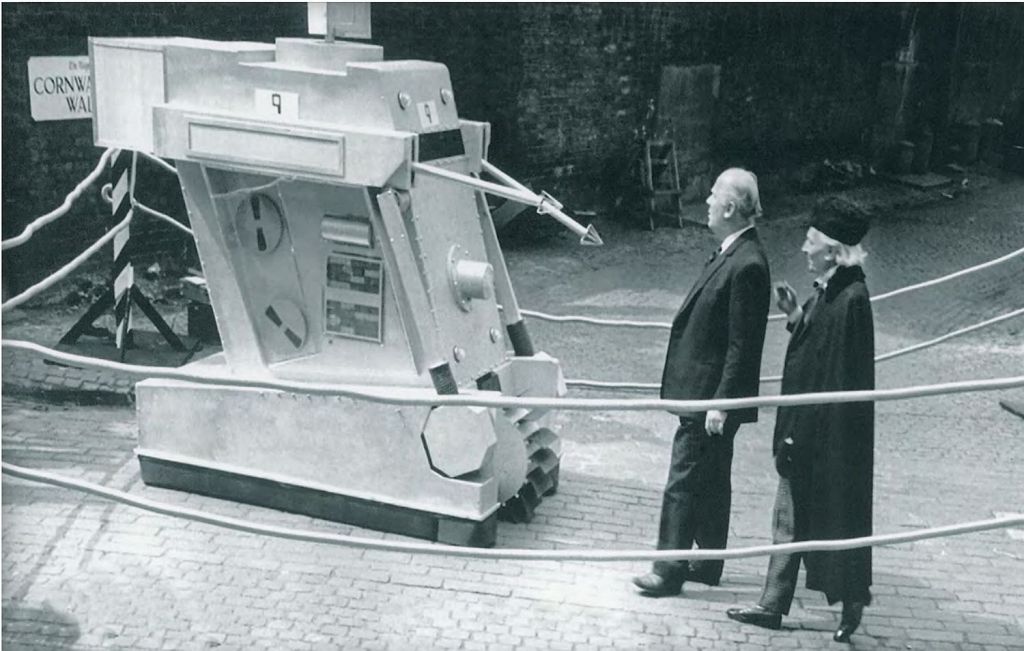
Closing out Hartnell’s third season as The Doctor, The War Machines brings with it an invasion story; the first to be set on modern-day earth. A four-part serial, it sees The Doctor, Dodo, and new companions Ben and Polly in a fight against time to save the Earth from a supercomputer with aspirations of conquering the Earth.
Schemes of a Supercomputer
Ian Stuart Black’s second entry into the Doctor Who franchise (The Savages being first) is a bit of a landmark story in hindsight. Not only is it the first story since Planet of the Giants to feature 60s Earth, but it also represents Doctor Who’s first attempt at a modern-day invasion story that features the ‘new technology equals bad’ trope. Set around the newly opened Post Office Tower (now the BT Tower), its histeria is focused upon a a specially built supercomputer known as WOTAN (Will Operating Thought ANalogue). The most intelligent machine of its kind, it is able to answer any question correctly, but, in the process, it has become sentient and has a desire to take over the Earth. It’s a simple plot, but one that will be used as a blueprint for many future invasion stories throughout Doctor Who’s history.
As a first attempt, The War Machines is certainly a facinating example, and one that represents a bit of a change to how Classic Who stories would be run going forward. More action-heavy and broader in scope, it’s able to flesh out its 90-minute runtime a lot more smoothly. Throughout, we’re given a lot more in terms of how the resistance to the War Machines is formed. These segments run between The Doctor and Sir Charles formulating a government and army response whilst Ben and Polly do some of the heavy lifting trying to get enough evidence to cut through the beaurocracy. It’s a more systematic and grounded approach than that of the Doctor single-handly saving the day, and it does pay dividends in making everything come together, including the climax as The Doctor comes face to face with these deadly machines.
Black’s more grounded approach to forming a resistance is also found within the plans of the invading force as well. There is no thought spared in the creation of these deadly War Machines and how it would potentially come to fruition during the 60s period. I love the sheer graft and industralism shown in building these machines, and the fact that there are no shortcuts taken to ensure that everything goes off without a hitch. As you would expect from a 90-minute story, we are given all of these interesting insights, including all the tests that needed to be performed before they are invasion ready.

Despite these landmark moments, this first attempt at a modern-day invasion isn’t without its flaws. Given Black’s grounded approach, it’s perhaps surprising that there are scant few details surrounding WOTAN’s inception and its masterplan. After the climax, the plot leaves several aspects about the antagonist up in the air. Firstly, no explanation is ever given in script as to how WOTAN gained sentience. As far as we are given in the story, WOTAN just becomes this independent being with no impetus whatsoever. Secondly, WOTAN’s motivations towards world domination aren’t particularly clear either. Beyond fulfilling the new technology trope, WOTAN’s plans are pretty one-dimensional, and are reminiscent of being an antagonist for the sake of the trope rather than anything more concrete.
The Swinging Sixties
Worldbuilding is always an incredibly strong aspect to any Ian Stuart Black story. Within his second story for the series, he manages to push past some of the more mixed moments of the plot to create something truly special. Being the first story in two years to be set in the present day, The War Machines had some pretty almighty shoes to fill. In response, Black’s approach is to quite literally take the next stage on from what we saw all those episodes ago.
Moving on from a school setting, Black takes us right into the of what would’ve been young adult popular culture during the swinging sixties. His ideas culminate in a centralising of part of the story within a popular dance club. Known as Inferno, the club plays an important role in several different capacities during the first two parts of the story.

Amidst the dancers and the loud music, the club is centre stage for The Doctor and Dodo to meet new companions Ben and Polly – both happening to be 20-somethings enjoying a bit of freedom. The club also becomes the focal point for early parts of the investigation into WOTAN and its killer machines when they take their first victim within the vicinity of the club.
Besides exploring 60s youth culture, Black also makes a point to build fear of the War Machines by establishing reactions to the antagonists throughout London. Mainly short scenes focusing in on pubs and local newscasts, they nevertheless create a good impression of London as a lived-in city, and especially of the type of panic that would be created by these killer machines.
One Out, Two In
Amidst its landmark storytelling, The War Machines is also, rather unfortunately, made infamous for an entirely different reason. Not only does this story introduce two new companions, it also sees one make their exit. During episode 2, Dodo is given her marching orders in perhaps one of the most unflattering ways possible.
In many ways, unflattering is a good term to describe Dodo’s time in the TARDIS. Lasting a mere five stories, she’s never really given anytime whatsoever to blossom. It doesn’t help that her introduction to the series is more of an afterthought than anything else, it is as if the writers and producers never really cared about her character. It’s no wonder then, that when it came time to say goodbye to her character, she’s given the same level of forethought. Under the influence of WOTAN for most of her time onscreen, she’s unceremoniously sent away to the countryside after The Doctor breaks her free of her trance. This is the last we see of her character. She’s given no real exit, no chance to say goodbye, and her departure is barely acknowledged by The Doctor despite Ben and Polly’s questioning. Even by Classic Who standards, her exit is unfinished and unflattering. The only answers we get to her life beyond the TARDIS come from extended universe material, which isn’t great either.

Conversely, Ben and Polly get a good introduction as companions in this story. Helped by the four-part format, we get to lean quite a lot about them over the course of their first story together. Ben is immediately seen as a bit of an action man figure, much in the same vein as Ian and Steven. A new navy recruit, he has a bit of an old-fashioned view of the world, especially when it comes to gender roles and posh women (often calling Polly ‘Duchess’ in a derogatory manner). Polly, meanwhile, is a young, highly-educated independent woman. She’s more progressive and curious, which often gets her into more scrapes and sticky situations.
Featuring interesting trope explorations, a fascinating insight into 60s culture, and an overall grounded approach to its sci-fi, The War Machines is deserving of its place as a landmark story in the history of Doctor Who. A great introduction for new companions Ben and Polly, the story echoes Earth invasions in the series for decades to come with WOTAN becoming the template for many villains to come. It’s not without its flaws (Dodo’s departure and WOTAN’s unexplained plans amongst them), but it is great for what it gives us.
My Rating: 8/10
Are you enjoying this new series? What would you like me do next? Share your thoughts by leaving a comment down below! Alternatively, you can help support the blog by donating through Ko-Fi.
Check out this previous review – The Meddling Monks.







Leave a Reply