

The third story in season 4 sees the latest instalment of the Dalek’s schemes. A six-part serial, the story is set on the Earth colony of Vulcan, which is on the verge of a rebellion. Within the mercury pits, however, something a lot more dangerous has been discovered. As a newly regenerated Doctor finds out, the colonists have dredged up the most dangerous species in the universe… The Daleks!
New Face, New Tricks
Like the story before it, The Power of the Daleks is another landmark in the history of Doctor Who. Following on from The Tenth Planet, this is the first story to feature a post-regeneration adventure.
What would become key to keeping the series fresh for so long, building solid foundations for an entire era is difficult, especially if you’re attempting it in one story. It’s a delicate yet instrumental craft that even modern writers with many examples still struggle to get right. Couple this with the fact that Whittaker had the daunting honour of tackling the first attempt, and you might assume that things didn’t go quite to plan. Fortunately, that is the complete opposite of what happens with this serial. Careful not to add too much into the mix, Whittaker strips The Doctor’s character down to its very instinctual basics, an approach that is admirable, perhaps even crude, but ultimately revolutionary.

Within the confines of the serial, what works so well for Whittaker is his insistent focus on The Doctor’s analytical skills and his natural ability to manipulate. After a short post-regeneration and trauma sequence (especially by modern standards), this manifests as The Doctor’s playing of his recorder no matter the social construct. Although this will be turned into a quirk more than anything else later in his era, what the Doctor uses it for in this story is not just as an annoying tool. The recorder’s harsh tones are a way for The Doctor to distract and gain the upper hand. Caught off guard by his incessant whistles through conversations, silences, and interrogations, The Doctor can gauge the type of person he’s dealing with and what type of actions they’ll take in a given, difficult situation. This is how The Doctor forces Bragan, leader of the rebels, to make some slip-ups of his ambitions and how Polly and Ben slowly begin to believe the man in front of them is really The Doctor.
Daleks Conquer and Destroy
Whittaker’s head for Doctor Who also strikes up some magic with The Daleks and the main plot of the story.
What Whittaker does with The Daleks and their plot during this story is nothing short of magic. Much like The Doctor, this adventure finds the Daleks needing to be at the peak of their scheming abilities. Why? Because, for more than half of the story’s runtime, the Daleks are disadvantaged. Despite their overwhelming strength, even a centuries-long dip in a bath of mercury is enough for The Daleks to need power from external sources in order to keep functioning.

While handicapping any villain has the potential to make them seem weak, in the case of The Daleks, this only adds to their already sinister nature. For them, being on the backfoot actually widens their destructive scope. Without the power to make them independent, Whittaker makes these Daleks into clever tacticians by necessity. From as early as episode two’s awakening scene, we’re given a glimpse into The Dalek’s ruthless underdog strategy. Within this scene, a lone Dalek is only given a couple of moments between Lesterson’s tests to figure out what’s going on between the colonists, as the scientists talk about it amongst themselves. Moreover, this same Dalek is also able to exterminate a doubter and disguise it as Lesterson’s mistake in a later scene.
From what the Dalek learns in these scenes, it formulates a way to continue getting the power it needs by acting as the colonists’ servant. During these episodes, the Dalek seemingly does everything (through the colonist’s point of view) to ingratiate itself to them. Fetching liquid, obeying orders, and even putting itself to work to help the ailing machines that keep Vulcan functioning. As a result, and despite The Doctor’s continued warnings and other colony distractions, the Daleks are given a place within the colony and a continued supply of their much-needed power.

By the time the climax rolls around, The Daleks are essentially all-powerful thanks to the colonist’s trust and negligence. Their waiting strategy pays off, and they unleash a vicious wave of death and destruction, killing the majority of the colony because their power is back and they’ve become disposable. In the end, it’s only a last-minute gambit by The Doctor, Ben, Polly and Lesterson that overflows their static electricity supply, ultimately destroying them.
A Rebellion on Vulcan
Between The Doctor’s post-regeneration and the Dalek’s schemes, there is also a third plot in this story that deserves attention revolving around a rebellion on Vulcan. Despite rebellion plots being a dime a dozen in the series, this is one the best examples and manages to keep the pace of this six-part serial on an even keel. Led by Janley, Lesterson’s assistant, her group of rebels hope to take control of the colony, all the while unaware that her double agent, Security Leader Bragan, is using the rebels for himself to cement his place as governor.
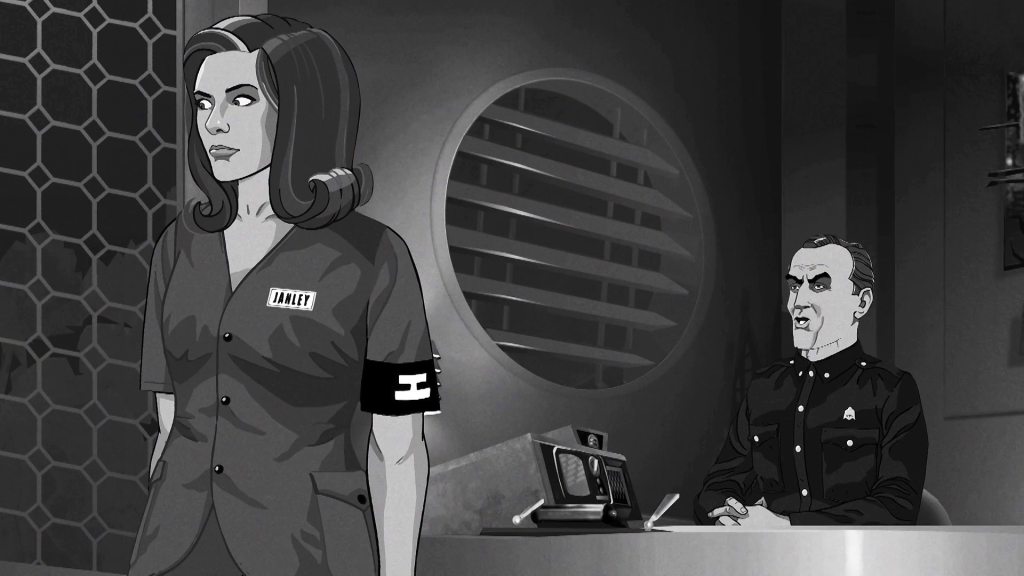
Whatever their original plans were for overtaking the colony, they end up falling by the wayside after the introduction of the Daleks. Convinced of their deadly effectiveness, Janley and Bragan move to utilise them for their own gain, a move which would ultimately lead to their destruction. Their hubris and double-crossings make for a satisfying moment of realisation, as the Daleks, in a way they were always intending to, double-cross them, exterminating them and the ordinary colonists in much the same manner. It’s a hauntingly effective scene, as the camera pans over swathes of the exterminated, and Tristam Cary’s sinister funeral synths blare.
Lesterson, while not associated with the rebellion, gets his own comeuppance with hubris in these moments as well. A well-meaning yet foolish scientist, he’s mislead by both Janley and The Daleks to give them everything they need to cause the story’s climactic devestation. Horrified by what his actions caused, he ultimately redeems himself in the final act, sacrificing his life so that The Doctor, Ben and Polly can overload The Dalek’s power systems.
Featuring a landmark post-regeneration story, a set of sinister scheming Daleks and an overwhelmingly well-paced six-part serial, The Power of the Daleks is one of the strongest stories in the 2nd Doctor’s entire run and perhaps one of the strongest in the history of Doctor Who at large. It serves as a great introduction for the 2nd Doctor, and its stripped-back approach, creating a more instinctual main character, is revolutionary, and an approach I’d love to see tried again in the future.
My Rating: 10/10
Are you enjoying this new series? What would you like me do next? Share your thoughts by leaving a comment down below! Alternatively, you can help support the blog by donating through Ko-Fi.
Check out this previous review – Oil and Water.







Leave a Reply